Category: Recovered

  • Myth: Oregon police time and resources aren’t spent on marijuana offenses.

    MythvsFactHandcuffsMyth: Most of the statistics of marijuana “arrests and citations” are simple citations. They are like speeding or not signaling the right way. They take very little resources.

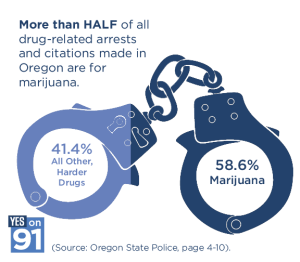
    Reality: More than half of the drug-related arrests and citations made in Oregon are for marijuana. (Source: Oregon State Police, page 4-10). In 2012, the most recent year for which data is available, 21,856 people were arrested or cited for drug crimes, and 12,808 of them were for marijuana.

    Marijuana-related policing has a huge cost. Police time is required to search, arrest, book, issue a ticket or lock someone up. In addition to the financial cost, every marijuana arrest and citation takes time that a police officer could have used patrolling a neighborhood, preventing an assault or solving a violent crime. Then there’s also the cost to the individuals, who will now have a marijuana crime on their records and may have trouble finding a job. Treating adult marijuana use as a crime is a drain on our resources.


  • Search Results for: {search_term}

    RT @KyleHD: My story with @RickSteves and #Measure91 http://t.co/xwPlyA6VF9

  • Travel as a Political Act with Rick Steves

    Rick Steves Books a New Kind of Tour: One to End Marijuana Prohibition in Oregon

    By Jill Harris

    Rick Steves Book CoverGuidebook author and TV host Rick Steves has traveled the world for three decades with an appetite for more than just new foods and cultures. He’s also had a keen interest in understanding how different countries address similar problems. As he notes in his book, “Travel as a Political Act,” one particularly serious issue he’s had his eye on is drugs. In part, “learning why Europe has fewer drug-related deaths, less drug-related incarceration, and less drug consumption per capita than we do here in America.”

    In a recent op-ed for The Oregonian, Steves summarizes his findings regarding marijuana:

    “When it comes to marijuana, some societies simply moralize and criminalize. Others are more pragmatic and work to reduce harm by taking the crime out of the equation, treating marijuana as a health and education issue instead…And it’s clear to me, we need to end our nation’s prohibition against marijuana.”

    Based on his experiences, Steves has been a longtime proponent of marijuana reform and was one of the original sponsors of Washington’s historic marijuana legalization Initiative 502, overwhelmingly adopted by voters two years ago. Rick aggressively campaigned for the initiative’s passage, arguing that his travels across the world confirm that marijuana is most effectively controlled through regulation. “Like most of Europe,” he said “I believe marijuana is a soft drug (like alcohol and tobacco), not a hard drug. Like alcohol and tobacco, there is no reason why it shouldn’t be taxed and regulated.”

    Screen Shot 2014-09-24 at 12.45.04 PMDuring the month of October, he’ll be using travel as a political act once again during a 6-day, 10-city tour of the state of Oregon to promote Measure 91, which would create a regulated system that would refocus police time on serious crimes, hobble the black market cartels, and direct millions of dollars to education, drug treatment and prevention, and law enforcement.

    As in other states and nations, in Oregon, the failed approach to marijuana has come at a steep cost:

    There have been at least 12,000 arrests and citations for marijuana each year across Oregon counties – and the number goes up every year. Over the last decade, police have arrested or cited over 99,000 people in Oregon for marijuana offenses. The millions of dollars this costs every year comes at a time when Oregon has untested rape kits, missing children and unsolved murders.

    The current failed approach to marijuana in Oregon supports a dangerous system of drug cartels, drug dealers and organized YesOn91-Cartelcriminals that take in huge amounts of profits without paying a penny in taxes.

    These criminals grow marijuana illegally on Oregon’s public lands and other delicate natural habitat, at with highly negative and lasting environmental impacts.

    Current marijuana policy in Oregon does nothing to protect children. Drug dealers control kids’ access to marijuana, and they don’t ask for ID. And drug education and prevention programs are woefully underfunded.

    Watch below as Steves narrates an animated video that explains in more detail how the current system is failing Oregon:

    Measure 91 is a smart law designed to address this reality and it was carefully crafted to create a tightly regulated system that controls marijuana’s production, sales and use – taking the best lessons from Washington and Colorado’s laws and improving on them. It’s been endorsed by Richard Harris (one of the state’s top drug treatment and addiction experts), former U.S. Attorney Kris Olson, retired Supreme Court Justice Bill Riggs, labor groups, environmental groups, senior citizen organizations, The Oregonian, The Eugene Register-Guard, The East Oregonian and more — an impressive list of well-respected leaders.

    “There are so many reasons to end the prohibition on marijuana,” says Steves. “Whether you want to improve the well-being of children, redirect money away from criminals and into tax revenue for the state or protect civil liberties, it’s clearly time for a new approach. Rather than being ‘hard on drugs’ or ‘soft on drugs,’ by passing Measure 91, Oregon can finally be smart about drugs.”

    If you’re in Oregon, check out the dates and locations of Steves’ tour and come listen to him share what he’s learned through his travels, why this experience makes him concerned about Oregon’s current approach to marijuana, the track records thus far of both Washington state and other countries, and where the drug reform movement is heading.

    Learn more at www.VoteYESon91.com/RickSteves.

    Jill Harris is the managing director of strategic initiatives for the Drug Policy Alliance.


  • New Poll: Majority of Oregonians Support Marijuana Regulation

    New polling demonstrates that a strong majority of Oregon voters are ready to regulate, tax and legalize marijuana like beer and wine. This recent polling continues a larger trend that we have been seeing across the country as more and more voters understand that prohibition is too costly and doesn’t achieve any of its stated goals. A well-regulated system will better ensure that we keep drug cartels from profiting off of the Oregon marijuana trade and that marijuana stays out of the hands of children. Licensed and regulated retail outlets will do a much better job of checking identification and removing the criminal element out of marijuana commerce than the black market. It is very heartening to see that Oregon voters are ready to regulate marijuana.

    From Firedog Lake:

    According to a survey by DHM Research for Oregon Public Radio, 53 percent of voters in Oregon would support legalizing marijuana for adults age 21 and older. Only 38 percent of voters in the state oppose legalization.

    Back in 2012 voters rejected ballot measure 80, Oregon Cannabis Tax Act, in a vote of 46.75 percent to 53.25 percent. That measure did suffer from criticism regarding its oversight provisions for the newly legalized industry.

    It is very likely the people of Oregon will have a chance to vote on marijuana legalization again this year. There are currently two campaigns gathering signatures to make it on the 2014 November ballot. One campaign is offering an revised version of their failed 2012 ballot measure and the other is New Approach Oregon with an initiative similar to the Colorado law.

    We look forward to providing Oregon voters the opportunity to establish a well-regulated system that licenses commercial producers, processors and retailers under the regulatory jurisdiction of the OLCC. This regulated system will generate millions of dollars for education, public safety and mental health and substance abuse programs. Additionally, law enforcement resources will be better prioritized as officers will have more time to combat serious and violent crime. Please join our campaign to pass marijuana regulations this November by adding your voice to the majority of Oregonians who understand that it is time for a new approach.


  • New York Times endorses Measure 91

    3 Reasons Why The New York Times Endorsement is a Big Deal for Oregon

    1. The New York Times has authority on the topic:

    After in-depth consideration of both sides of the issue of marijuana legalization, the New York Times came out this summer with a series of six thorough and thoughtful opinion pieces on the reasons to, and results from, establishing a regulated, legal system of controlling marijuana. You can see the series HERE. As the ‘paper of record’ in the United States, the New York times is the guiding light for all print media in today’s public discourse.

    Now the Times has put their money where their mouth is and written a piece urging all three locales with marijuana legalization on the ballot in the US – Oregon, Alaska and the District of Columbia – to continue the movement of reforming marijuana policy. Below is the section about Oregon.

    2. The endorsement joins that of three Oregon newspapers (thus far), including the state’s two largest newspapers:

    The Oregonian and The Register Guard, the two most-circulated papers in Oregon, are also urging voters to pass Measure 91. The Times also joins The East Oregonian in support of Measure 91 which demonstrated the breadth of support across the state. This support is even more notable considering that none of these papers endorsed previous Oregon legalization measures.


    3. Public opinion is changing and the news media is reflecting that:

    Poll after poll shows that a growing majority of Oregonians and Americans support a regulated, legal system of marijuana in which it is taxed and better controlled. That’s why these papers and many organizations and individuals who haven’t previously supported marijuana reform, are coming out in favor of Measure 91, a sample of which includes:

    • Two senior citizen organizations: The Oregon Council for Retired Citizens and the Oregon Alliance for Retired Americans;
    • Labor organizations like AFSCME locals 88 and 328; and the United Food and Commercial Workers, Local 555
    • Professional organizations such as the Oregon Chapter of National Association of Social Workers, Oregon Criminal Defense Lawyers Association, the Portland City Club and many more.

    Here’s what the paper of record had to say about Measure 91:

    OREGON Measure 91 would also set a minimum age of 21. It would give the Oregon Liquor Control Commission the power to regulate marijuana as it does alcohol, and would direct it to review tax rates regularly. The tax — initially set at $35 per ounce for flowers and $10 per ounce for leaves — should allow for prices low enough to compete with street dealers. Since it is already extremely easy for adults in Oregon to obtain medical marijuana cards (almost 65,000 Oregonians have one), recreational legalization will not be a big change. As The Oregonian editorialized in August, the measure would “be worth supporting for reasons of honesty and convenience alone.”


  • Why Yes on 91 is a better approach in only 45 seconds

    Why we need marijuana regulation in :45 seconds flat

    Our team worked hard on this short video presentation that shows why it’s time to regulate, legalize and tax marijuana in Oregon. You might recognize the narrator’s voice from the radio and television; it’s travel guru Rick Steves.

    He’s been around the world and seen how other societies tackle complex social issues. Steves agrees with a growing number of Oregonians, and millions across the country, that it’s time for a better approach to marijuana. It starts with voting Yes on Measure 91.


    Hop on Twitter and Facebook! Share this video with your friends and family using- bit.ly/M91MotionInfo -Spread the word on Measure 91. #VoteYesOn91

    ***

    Screen Shot 2014-09-24 at 12.45.04 PMRick Steves is visiting a town in Oregon near you soon. Click here to RSVP to one of his events. They’re filling up fast. He’ll talk travel and how Measure 91 is a better approach to marijuana regulation.

    If you can’t attend, or you want to keep up with Rick on the tour, search #RickYESon91 on Twitter.


  • East Oregonian Newspaper: Yes on 91

    Measure 91: Marijuana legalization, Price too high to combat vice

    Another Oregon newspaper agrees that regulating, legalizing and taxing marijuana is superior to allowing the current criminal system to continue and the waste of police resources to East Oregoniango on. The East Oregonian has endorsed a Yes vote on Measure 91, joining The Register-Guard in Eugene and The Oregonian.
    The East Oregonian’s endorsement acknowledges the ruins left behind by using law enforcement to try to regulate the marijuana market. Oregon spends more than $50,000,000 a year enforcing marijuana laws, more than 13,000 people were arrested last year alone and people of color are unjustly burdened by enforcement of prohibition- more than twice as likely as white to be arrested or cited in Oregon.

    From the paper’s editorial endorsement:

    “We spent millions — then billions — to combat it. We toppled governments in our own hemisphere to stop its cultivation. We imprisoned millions of our (mostly black) citizens as punishment for using it. We forbid our scientists from researching its effectiveness for medical uses.

    All of that, to very little avail. Marijuana continues to abound in Oregon, from high school hallways to back alleys to suburban basements.

    Finally, drug policy across the nation has been changing…. The opportunity to incorporate a policy that is similar — but better — than those in Colorado and Washington will be in front of voters in November… we support the passage of Measure 91. “

    You can read the entire editorial here, however it is behind a pay wall and requires a fee.


  • Experts Discuss the Success in Colorado & Washington

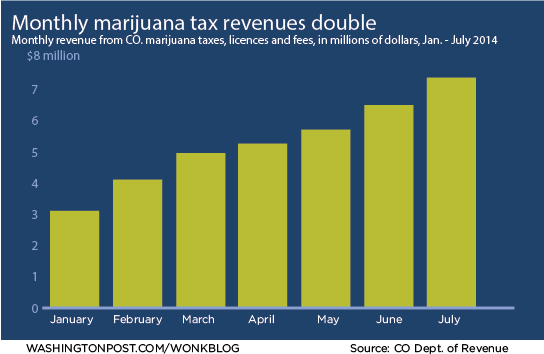
    Colorado and Washington have both dramatically decreased the number of marijuana arrests in their respective states, saving resources and better focusing police resources. Additionally, they are generating millions of dollars that is funding education, research and drug prevention programs. On a conference call with media from across the country, various experts discussed the benefits regulating, legalizing and taxing marijuana has brought to the two states and how, despite false claims to the contrary, the sky is not falling.

    BLOGCOrevenue

    In Colorado, the state has seen marijuana possession arrests decrease by 80%, freeing up police to focus on more serious and violent crime, while violent the violent crime rate has decreased and the state has generated millions of dollars in new revenue. On the Tuesday conference call, retired Denver police officer Tony Ryan remarked that police officers don’t want to waste time on marijuana and that regulating marijuana allows for police time to be devoted to combat real criminals.

    “Chasing marijuana smokers was not at the top of my list because I needed my officers to handle calls for service,” Ryan said. “We didn’t have enough officers to cover calls, in part because of the distraction of doing narcotics enforcement, and when you’re enforcing narcotics laws, you’re mostly enforcing marijuana laws. This frees up police officers to do what they’re supposed to do—answer calls for service and work on solving crimes.”

    Art Way of the Drug Policy Alliance also noted that highway fatalities are near historic lows and that teen use of marijuana has actually decreased while Colorado teens find marijuana harder to get than the national average. Lewis Koski, Director of Colorado’s Marijuana Enforcement Division informed everyone on the call that not a single marijuana dispensary would sell marijuana to an underage buyer. “We put undercover underage individual into the retail stores to see if they could buy anything, but what we’ve seen is a 100% compliance rate,” he said.

    Washington has also seen a dramatic decrease in marijuana arrests as only 120 marijuana arrests were made in 2013 after 5,531 arrests were made in 2012 and 6,879 in 2011. Seattle City Attorney Pete Holmes stated on the call that the state is saving law enforcement time and money due to marijuana regulation and the ACLU’s Allison Holcomb commented on the fact that highway fatalities and accidents have not increased.

    Former Seattle Police Chief Norm Stamper also saw regulating, legalizing and taxing marijuana as a smart move for Colorado:

    “It’s no secret that relations between police officers and the communities they are required to serve are strained, especially with young and poor people, and marijuana enforcement is a big factor in this,” Stamper argued. “A vast number of poor young people of color have been arrested over the years. With I-502, there is a major shift in law enforcement priorities. Now, police can focus on burglaries and robberies and the like, and by freeing up resources, we can also deal a serious if not fatal blow to major drug dealers. This is making a huge and positive difference.”

    It was great to hear from experts on the ground in Colorado and Washington share their experiences. Oregon has learned a lot from Colorado and Washington, taking the best from both states marijuana regulatory measures to craft a bill designed for Oregonians. Measure 91 will allow Oregonians to better prioritize our law enforcement resources, freeing up police time that is better spent finding missing children and solving unsolved rape and murder cases. Our current marijuana policy is broken; it’s time for a better approach. It’s time that we focus our police resources on what’s really important.


  • Oregon Marijuana Citations & Arrests by County

    Number of Marijuana Citations and Arrests in Oregon Each Year

    Some district attorneys in Oregon say they don’t arrest or sentence people for marijuana offenses. They say that possession of one ounce isn’t treated like a crime in Oregon (even though buying or selling it is).

    The Oregon State Police say that over 13,000 people in Oregon were arrested or cited for marijuana offenses last year.

    unnamed-2

    The Better Approach to Marijuana

    Treating marijuana use as a crime has failed. It fuels drug cartel violence and doesn’t protect children. And Oregon has wasted far too many resources that could be better spent on higher priorities like serious crime, schools, youth prevention and mental health.

    unnamed-3


  • The Register

    The Yes on 91 campaign continues to pick up prominent endorsements, all across the great state of Oregon. The Register Guard, the#1 media source in Lane County, has joined the growing coalition of Measure 91 supporters who know that treating marijuana as a crime has failed and that Oregon can do better.

    Oregon is arresting and citing more than 10,000 people every year, well over 100,000 people over the last decade. And these arrests and citations disproportionately fall upon people of color and adversely harm those with low incomes. Across Oregon, African Americans are 100% more likely to be arrested for marijuana while that number climbs to 350% in Lane County. These charges have real consequences on real people’s lives as they can disrupt employment and housing opportunities.

    Arresting and citing thousands of people for marijuana every year distracts police resources from serious and violent crimes. Our state has unsolved murders, missing children and untested rape kits that are all more important priorities. The time and resources it takes to arrest people for marijuana negatively impacts our ability to tackle more important issues. Let’s stop a nonsensical policy that enriches criminals and underfunds our state.

    It is time to refocus our police resources and, instead of putting money into the hands of criminals, fund education, drug treatment and public safety. The Register Guard heard from all sides of this issue and urges Oregon voters to vote “YES” on Measure 91:

    “Prohibition keeps drug dealers in business — dealers who have no compunction against selling pot and other drugs to children, selling products of dubious purity and feeding profits to organized criminal enterprises. Measure 91 would pinch one of the conduits for the cash that finances drug cartels by bringing much of the underground marijuana economy into the open, where it could be monitored, regulated and taxed.

    “Under Measure 91, legal sales of marijuana would be taxed at a rate of $35 per ounce — a rate low enough to ensure that licensed outlets could compete with illicit sources, yet high enough to generate revenue for the state. The Legislative Revenue Office estimates that marijuana tax revenues in the first biennium would amount to $46.6 million. Forty percent of the money would be dedicated to public schools, 35 percent to law enforcement and 25 percent to drug education, treatment and mental health programs.

    “Revenues flowing directly to the state would be only part of the picture. The entire marijuana supply chain would move out of the shadows. Pot that is currently grown on booby-trapped plots on public lands would be produced by licensed, tax-paying farmers. Processing, distribution and retailing would generate taxable profits and wages.”

    With The Register Guard’s endorsement, Oregon’s two largest daily newspapers have now endorsed Measure 91. They are adding to a chorus of experienced experts and organizations that include: Richard Harris, retired director of the Oregon Addiction and Mental Health Services Division; the Partnership for Safety and Justice; retired Oregon Supreme Court Justice William Riggs; and former US Attorney Kris Olson, who served as the chief federal prosecutor in Oregon. You can add your voice to the growing majority of Oregonians who know that it is time to better prioritize our police resources and fund education, law enforcement, drug prevention and drug treatment.