Blog

  • Why Vote Yes on Measure 91? THE BOTTOM LINE

    There are many reasons to vote for Measure 91, and many ways to talk about it. But there are some very basic facts that make up the bottom line of why to vote Yes.

    Our current marijuana laws simply don’t work.

    • They cost a fortune.
    • They empower and enrich criminals and drug cartels.
    • They distract law enforcement from serious crime, with over 99,000 arrests or citations over the last 10 years (one every 39 minutes).
    • They don’t curb marijuana use.
    • They ruin lives.

    Tightly regulating and taxing the growth, sale and use of marijuana is a better approach.

    • It legalizes marijuana use for adults 21 and older only.
    • It provides strong protections against use by youth, including funding for proven, effective education and prevention programs.
    • It maintains current driving under the influence laws and drug-free workplace rules.
    • Taxing marijuana provides tens of millions of dollars for vitally important needs, with 40% to schools; 35% to state and local law enforcement; and 25% to drug treatment, prevention and mental health programs.
    • By law, the money goes into a special account and can only be spent as directed.

    What will Oregon look like after Measure 91 passes?

    • We will have taken money and power away from the black market and drug cartels.
    • We will have provided protections for neighborhoods and kids.
    • We will have funded schools, public safety, prevention and mental health.

    And Measure 91 was written to take the best lessons from the experiences of Washington and Colorado’s laws, making this the right measure at the right time.

    That’s why 146,708 Oregonians – from east to west and north to south –
    signed the petition to put this important measure on the ballot.

    VOTE YES ON MEASURE 91
    It’s the better approach for Oregon.

    (This information furnished by Anthony Johnson, Chief Petitioner, Yes on 91.)


  • Protect Rural Oregon With Measure 91: Get rid of violent drug cartel grow operations and create agriculture jobs

    Our beautiful, wide ­open land drew pioneers to Oregon. Now many of our rural lands have attracted something far worse. Foreign drug cartels are farming marijuana on pristine land in our counties, taking advantage of our cash-­strapped law enforcement to feed their black market operations.

    Let’s vote to regulate, legalize and tax marijuana to cut off the black market and send the cartels packing. Rural Oregon has so much good, we don’t want to be known as ground zero for drug gang activity.

    These illegal grows are a scourge:

    • Thugs with guns roam remote areas; any family out camping could suddenly land in danger.
    • Chemicals are used without regard for safety or how they might contaminate our water.
    • Forest land is booby ­trapped to protect illicit fields.

    Measure 91 taxes legal marijuana. Instead of dumping money in a big bank account for Salem, it’s written into the law that the money will be spent on schools, law enforcement, and drug treatment and education. Our sheriffs’ offices will get money to help bring back 24 ­hours service so when we call 911, someone is there to help. Our jail beds will be reserved to keep dangerous criminals off our streets instead of jailing non­-violent marijuana users.

    Most of us know someone who needs a job. Growing marijuana and hemp is an industry waiting in the wings right now. Beyond farming there’s manufacturing. Hemp can be made into more than 20,000 products. We have a real pioneering spirit here in Oregon, let’s put it to use.

    Tolerating violent drug cartels in our midst is making our communities less safe. We can end the black market for marijuana and create jobs for hard­ working people in rural Oregon. Let’s boost funding for our kids’ schools and bring back our public safety officers. Vote Yes on 91 for the good of all Oregonians.

    This information furnished by Dan Mahr, Campaign Manager, Vote Yes on 91.


  • Mayor Tim Leavitt of Vancouver, Washington says: Switching from drug cartels to a legal, regulated industry is working here

    Soon Oregonians will decide whether to legalize marijuana for adults 21 and older.

    Based on our experience across the Columbia River from Oregon, I can tell you that this is the right time to do it.

    In Washington we have been methodical in implementing our new marijuana law. It’s going well and is far better than the black market system we had before.

    • In Vancouver, we want to create a positive business climate for hardworking entrepreneurs and their customers so that businesses contribute to the city’s well-being. Retail marijuana customers coming to Vancouver also financially support other area businesses when they visit.
    • The black market, now facing competition, is in decline. Growers and shop owners go through a rigorous licensing process designed to eliminate anyone with a questionable background.
    • Vancouver and Washington are enjoying additional revenue from legal marijuana sales: In the first 30 days of sales at retailers, more than $1 million poured into state coffers through the new taxes on marijuana.
    • Police are spending time on more important crimes: Prior to legalization, Washington police arrested over 5,000 people a year for marijuana offenses, and now it’s down to under 200. That frees police up to address violent crime.

    With Measure 91, Oregon has a thoughtful way forward to more sensible policies towards marijuana.

    While things are going well, we’ve also learned a lot from the legalization experience here in Washington and in Colorado. Measure 91 is designed to take advantage of those lessons and improve upon them for Oregon. And Measure 91 has built-in flexibility to adjust the law in the future if needed.

    The view from the other side of the river is clear: legalizing marijuana for adults over 21 works – and with Measure 91, it will work for Oregon too.

    (This information furnished by Tim Leavitt.)


  • The Financial Impact of Measure 91

    Several economic studies have been conducted to project tax revenue from yearly marijuana sales. The following chart summarizes the studies, and the graph displays the first-year revenue projections. To learn more about the studies, or read them in their entirety, scroll down.


    The Budgetary Implications of Legalizing Marijuana in Oregon

    This report estimates the reduction in government expenditure and the increase in tax revenue that would result from legalizing marijuana in Oregon. Legalization would reduce government expenditure by about $70.84 million annually. Legalization would also generate tax revenue of roughly $37.15 million annually if marijuana were taxed at rates comparable to those on alcohol and tobacco.

    Dr. Jeffrey Miron
    Senior Lecturer and Director of Undergraduate Studies
    Department of Economics Harvard University

    Abhi Sivasailam Director of Research
    American Victory Coalition

    Ankur Chawla
    Policy Analyst American Victory Coalition

    Oregon Cannabis Tax Revenue Estimate

    Economists at ECONorthwest conducted an independent study to estimate the amount of money that would be generated in the short term if the Act passes. The money generated in taxes would go to schools, state and local police, and programs for drug treatment, prevention, drug education, and mental health.

    The key findings of this analysis are:

    • $38.5 million in excise tax revenue would be generated during the first fiscal year of tax receipts;
    • $78.7 million in excise tax revenue would be generated during the first full biennium of tax receipts.

    ECONorthwest

    Beau Whitney Study

    Beau Whitney predicts that total FY2017 net revenue forecast of $21.2M (and $46.6M for the biennium) as a baseline and $9.1M (and $22.2M) for FY2017 on the low end.

    Beau R. Whitney
    Whitney Economics, LLC

    The Budgetary Implications of Legalizing Marijuana in Oregon

    The initiative, if approved by voters, would legalize and regulate the possession and cultivation of marijuana by adults, and tax the sales of marijuana and related products. We estimate that Initiative Petition 53 will produce up to $81,694,920 in annual tax receipts for the state of Oregon. We also estimate that Initiative Petition 53 could save state and local budgets up to $89,315,347 in annual expenditures, though this estimate is subject to considerable data limitations and should be interpreted carefully.

    Abhinav Sivasailam
    Director of Research, American Victory Coalition

    Ankur Chawla
    Researcher, American Victory Coalition

    Measure 91: State of Oregon Estimate of Financial Impact Statement

    This measure legalizes, regulates and taxes the manufacture, sale and use of marijuana in Oregon. State and local expenditures and revenues will be impacted by passage of this measure.

    The measure requires the Oregon Liquor Control Commission (OLCC) to license and regulate the distribution of marijuana. The revenue estimate from taxes when fully implemented may range from $17 million to $40 million annually.

    The OLCC estimates that the start-up costs are about $300,000 in state fiscal year 2015, about $2.5 million in state fiscal year 2016, and $1.0 million in 2017. OLCC annual operating expenses are estimated to be $3.2 million per year. New revenues are expected to be sufficient to offset these costs.

    The remaining revenue beyond expenses would be distributed as follows: 40% to the Common School Fund, 20% to the Mental Health Alcoholism and Drug Services Account, 15% to the State Police Account, 10% to cities for law enforcement, 10% to counties for law enforcement, and 5% to the Oregon Health Authority for alcohol and drug abuse prevention, early intervention and treatment services.

    The Oregon Health Authority estimates $200,000 per year in additional expenditures for two positions to license marijuana facilities that test marijuana products. This estimate assumes 20 such facilities. New revenues are expected to be sufficient to offset these costs.

    The Oregon Department of Agriculture estimates $100,000 per year in additional expenditures for one position to provide rulemaking related to marijuana-infused food products, engage in outreach to the food industry, and assist members of the food industry to achieve compliance with rules. New revenues are expected to be sufficient to offset these costs.

    Oregon State Police estimates that passage of the initiative would create a need for three additional Highway Interdiction Team detectives as well as training of all sworn members in Advanced Roadside Impairment Driving Enforcement and training of some members to join the existing pool of Drug Recognition Experts. The associated start-up costs for additional staffing and training are estimated at $400,000 in state fiscal year 2016 and ongoing expenses of $400,000 per year beginning in fiscal year 2016. New revenues are expected to be sufficient to offset these costs.

    The Oregon Judicial Department expects additional court costs to address OLCC rulemaking and licensing authority of between $21,417 and $55,902 in the 2015-17 biennium and between $13,068 and $47,190 per year in later biennia.

    Passage of the initiative may result in the reduction in the number of persons entering the public safety system for marijuana-related violations, thereby reducing state General Fund expenditures on community corrections. Passage of the initiative may result in a reduction in the dollar value of fines collected by state and local governments for convictions of marijuana-related violations. Therefore, the impact for state and local governments, district attorneys, and the courts is indeterminate.

    New jobs created will generate an indeterminate amount of income tax revenue.


  • The Council for Retired Citizens urges everyone to support Measure 91 to regulate, legalize and tax marijuana in Oregon.

    The Oregon State Council for Retired Citizens is Oregon’s oldest grassroots senior advocacy organization. It represents the state’s retired residents on issues relevant to aging and quality of life for senior citizens.

    For older Americans, marijuana can and does provide great relief for many conditions. However, when one is sick and in need of effective medicine, it can be difficult to get a medical marijuana card. And even if you can get a card, it’s often hard to get marijuana through legal means due to bans on dispensaries across much of the state.

    Consider this example: a local older couple became desperate to obtain marijuana to ease the side effects of the wife’s cancer treatment. First, their primary care doctor refused to fill a prescription for medical marijuana. Then they were unable to get a referral to a doctor who would do so. Finally they had to resort to the black market so she could get some relief.

    The lack of legal marijuana means that medical providers are nervous about having anything to do with it. Medical institutions aren’t conducting research to understand the course of treatment for marijuana. And there is no funding for clinical trials because it is still largely illegal.

    This is the first time a senior citizens organization in Oregon has endorsed a marijuana regulation measure. That reflects the fact that Measure 91 is a serious, well-crafted and better approach.

    In addition to controlling the growing, selling and distribution of marijuana, Measure 91 will:

    • Better protect youth by putting black market drug dealers out of business;
    • Improve access and information for the elderly and persons with disabilities who need medical marijuana;
    • Redirect police resources away from policing “marijuana criminals” to serious crime; and
    • Generate tax revenue to enhance education, public safety, and drug treatment and prevention programs.

    Vote Yes on Measure 91.

    (This information furnished by Steve Weiss, Oregon State Council for Retired Citizens.)


  • The American Civil Liberties Union of Oregon and Partnership for Safety and Justice Urge You to Vote Yes on Ballot Measure 91

    Keeping marijuana illegal and unregulated has resulted in the unnecessary diversion of limited public safety resources.

    According to statewide data collected by the Oregon State Police, there have been over 99,000 arrests and citations for marijuana offenses in Oregon over the past decade – the vast majority for simple possession. That means police and sheriffs are pursuing people who use marijuana and not focusing fully on preventing serious or violent crime.

    Arrests and citations for marijuana use and purchase exact great personal costs. There are steep fines for possessing even a small amount of marijuana and many marijuana charges carry the threat of long prison terms. For example, under current law, a person who grows even one marijuana plant for their own use could face up to 10 years in prison. Some people are saddled with a criminal record that creates barriers to employment, housing and student loans.

    What’s more, our current marijuana laws are enforced along color lines and create a significant racial justice issue: even though African Americans and white people in Oregon use marijuana at about the same rate, blacks are twice as likely to be arrested or cited than are whites.

    It’s time for a new approach, with sensible policies that lift the criminalization of marijuana use for responsible adults – 21 and older – and more sensibly and safely control how marijuana is produced and sold.

    • Measure 91 sets up a smart and regulated approach to marijuana that will redirect police and court time to more urgent public safety concerns.
    • Measure 91 means that marijuana will be taxed and funds will go to support, among other things, drug prevention programs that currently receive inadequate support.
    • Measure 91 supports a more fair criminal justice system.

    We urge you to vote Yes on Measure 91.

    (This information furnished by Rebecca Straus, American Civil Liberties of Oregon.)


  • Thank You

    Thank you for taking the time to get involved. If you would like to contact the campaign, please email info@newapproachoregon.com or call 971-285-3327.

    You can also connect with Vote Yes on 91 on Facebook, on Twitter, or on Instagram.

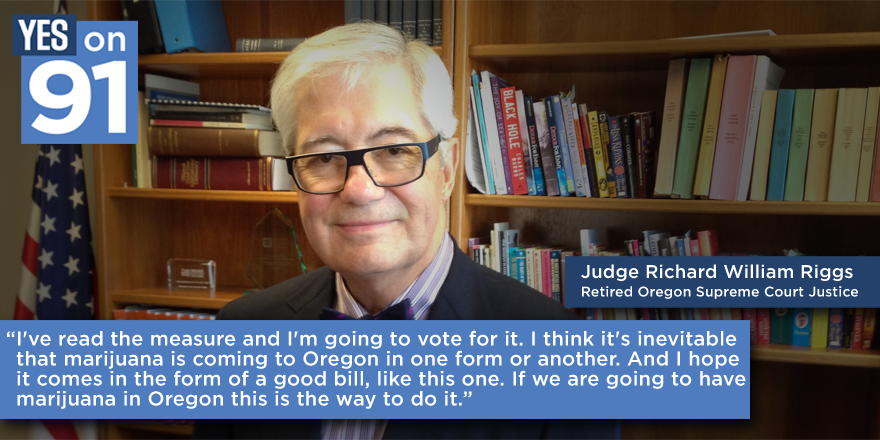
  • Retired Oregon Supreme Court Justice Riggs Says He Will Vote Yes on 91

    Retired Oregon Supreme Court Justice William Riggs shares why he will vote yes on Measure 91 – the better approach to marijuana. The November 2014 Oregon initiative will regulate, legalize and tax marijuana. Click here to watch the video.

    yo91_judge_riggs_graphic


  • Q&A: Richard Harris on why he supports Measure 91

    I sat down with Richard Harris to talk about why he supports Measure 91, and what it means for drug prevention and addiction programs.

    Richard Harris has worked in drug treatment and prevention for more than 30 years. As the former director of the Addictions and Mental Health Services in Oregon, he held the highest position in the state for directing drug treatment and addiction programs. He is also a founder and the former director of Central City Concern, which runs one of Oregon’s largest health and recovery programs.

    Why are you supporting Measure 91?
    We’ve been treating marijuana as a crime for decades. The numbers make it clear, that approach isn’t working. Measure 91 is a better way forward. It will safely regulate marijuana and possession at all levels, generate millions in tax revenue and improve our state.

    What’s wrong with our current approach to marijuana?
    Criminalizing marijuana is much more destructive than using it. The criminal sanctions split families, take jobs, ruin homes, cost taxpayers too much money and put people in jail, where they learn how to commit real crimes. The current approach doesn’t solve the problem for people who have real drug addictions and and dependencies.

    Some people say we should focus on reducing the availability of marijuana.
    Trying to keep marijuana out of people’s hands simply doesn’t work. The war against marijuana is distracting police from dealing with more important issues, like stopping violent crimes, and taking money away from what we know works with people who have drug problems — drug education, prevention and treatment.

    What do you like about Measure 91?
    Measure 91 deals with marijuana in a rational way, and we need the right restrictions put into place. Measure 91 controls marijuana from seed to sale; penalizes access by minors; keeps current laws against driving while impaired; keeps drug-free workplace rules, and prevents public use. The state would treat marijuana in much the same way it treats alcohol.

    How is Measure 91 an improvement over our current approach?
    Under Measure 91, the state would regulate and control marijuana and it would generate millions of tax money for drug treatment, mental health and prevention programs. Did you know that right now there is no state appropriated money in Oregon for drug and alcohol prevention programs? Measure 91 would fix that, improving access to both drug treatment and drug prevention services.

    Where is the money for drug prevention coming from?
    The state of Oregon appropriates zero money for drug abuse, including no money for marijuana prevention programs for youth. The limited amount of drug prevention money comes from the federal government, from local money from city or county governments and from fundraising through nonprofit programs. But under Measure 91, there would be new state funding for marijuana prevention, just as it has been the case in Washington state.

    What has Oregon learned from its past in terms of how it used to deal with alcohol?
    What a lot of people don’t know is that in many states it was a crime to be publicly intoxicated in Oregon. Up until the 1970s, people were taken to the city jail for being drunk. They received no treatment, addicts lost their families and hundreds of drunks were wandering the street during the day. Then, in 1971, Oregon became the second state to decriminalize public intoxication. A tax on beer and wine went into treatment and recovery programs. The results were dramatic. What we see today in public alcohol intoxication is a twentieth of what it used to be. What changed is that we shifted from criminalizing alcoholism to providing treatment for it. The same thing can work for marijuana.


  • Largest newspaper in Oregon: Vote yes on Measure 91

    croppedthumbnail_OregonianLogoVerticalThe Oregonian, the largest newspaper in Oregon, has endorsed Measure 91 to regulate, tax and legalize marijuana.

    It’s the first time The Oregonian has supported a marijuana measure, and the endorsement is one of a growing number from organizations and individuals who have come out in support of Measure 91. Other endorsers include William Riggs, the retired Oregon Supreme Court Justice; Richard Harris, Oregon’s leading drug addiction expert; the ACLU of Oregon; the Oregon State Council of Retired Citizens, United Food & Commercial Workers Local 555, conservationists; parents; teachers; nurses; and hundreds of others.

    The Oregonian’s endorsement encourages voters to consider the important positive impacts of legalizing marijuana with Measure 91:

    “Measure 91 would move Oregon from a hazy condition of almost-legalization to one of rational access guided by straightforward regulations and subject to sensible taxation. In other words, it would force Oregon’s 16-year-old marijuana experiment out of adolescence and into legal adulthood.”

    “The tax burden imposed by Measure 91 would be more modest than that adopted in Washington. Taxes would be levied at the point of sale by producers and would range from $5 per immature plant to $35 per ounce for flowers. These rates might strike some as too low, but taxing legal pot too heavily would merely give people an incentive to keep buying on the black market.”

    “Measure 91, far from revolutionary, would simply allow Oregon adults to obtain something they may obtain now, but without having to stroll through a “medical” loophole or drive over a bridge to a neighboring state. The measure would be worth supporting for reasons of honesty and convenience alone, but it also would raise millions of dollars per year for schools and other purposes. For that reason, it deserves support even from those who aren’t normally high on taxes.”

    We welcome the support of the state’s largest newspaper. Thank you for understanding that it’s time for a more sensible approach to marijuana in Oregon!