Colorado and Washington have both dramatically decreased the number of marijuana arrests in their respective states, saving resources and better focusing police resources. Additionally, they are generating millions of dollars that is funding education, research and drug prevention programs. On a conference call with media from across the country, various experts discussed the benefits regulating, legalizing and taxing marijuana has brought to the two states and how, despite false claims to the contrary, the sky is not falling.
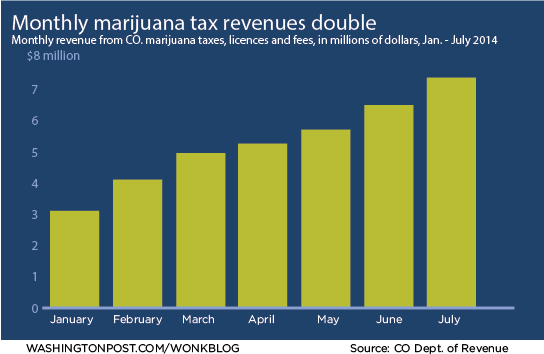
In Colorado, the state has seen marijuana possession arrests decrease by 80%, freeing up police to focus on more serious and violent crime, while violent the violent crime rate has decreased and the state has generated millions of dollars in new revenue. On the Tuesday conference call, retired Denver police officer Tony Ryan remarked that police officers don’t want to waste time on marijuana and that regulating marijuana allows for police time to be devoted to combat real criminals.
“Chasing marijuana smokers was not at the top of my list because I needed my officers to handle calls for service,” Ryan said. “We didn’t have enough officers to cover calls, in part because of the distraction of doing narcotics enforcement, and when you’re enforcing narcotics laws, you’re mostly enforcing marijuana laws. This frees up police officers to do what they’re supposed to do—answer calls for service and work on solving crimes.”
Art Way of the Drug Policy Alliance also noted that highway fatalities are near historic lows and that teen use of marijuana has actually decreased while Colorado teens find marijuana harder to get than the national average. Lewis Koski, Director of Colorado’s Marijuana Enforcement Division informed everyone on the call that not a single marijuana dispensary would sell marijuana to an underage buyer. “We put undercover underage individual into the retail stores to see if they could buy anything, but what we’ve seen is a 100% compliance rate,” he said.
Washington has also seen a dramatic decrease in marijuana arrests as only 120 marijuana arrests were made in 2013 after 5,531 arrests were made in 2012 and 6,879 in 2011. Seattle City Attorney Pete Holmes stated on the call that the state is saving law enforcement time and money due to marijuana regulation and the ACLU’s Allison Holcomb commented on the fact that highway fatalities and accidents have not increased.
Former Seattle Police Chief Norm Stamper also saw regulating, legalizing and taxing marijuana as a smart move for Colorado:
“It’s no secret that relations between police officers and the communities they are required to serve are strained, especially with young and poor people, and marijuana enforcement is a big factor in this,” Stamper argued. “A vast number of poor young people of color have been arrested over the years. With I-502, there is a major shift in law enforcement priorities. Now, police can focus on burglaries and robberies and the like, and by freeing up resources, we can also deal a serious if not fatal blow to major drug dealers. This is making a huge and positive difference.”
It was great to hear from experts on the ground in Colorado and Washington share their experiences. Oregon has learned a lot from Colorado and Washington, taking the best from both states marijuana regulatory measures to craft a bill designed for Oregonians. Measure 91 will allow Oregonians to better prioritize our law enforcement resources, freeing up police time that is better spent finding missing children and solving unsolved rape and murder cases. Our current marijuana policy is broken; it’s time for a better approach. It’s time that we focus our police resources on what’s really important.